
How to Buy Land in Assam: Complete Guide for Beginners (2026)
How to Buy Land in Assam: Complete Guide for Beginners
Buying land in Assam can be a good long-term investment, but it is important to understand the state’s land laws before paying a token amount or signing an agreement. Assam has specific rules relating to patta status, protected belts and blocks, agricultural land, land conversion, NOC, registration and mutation.
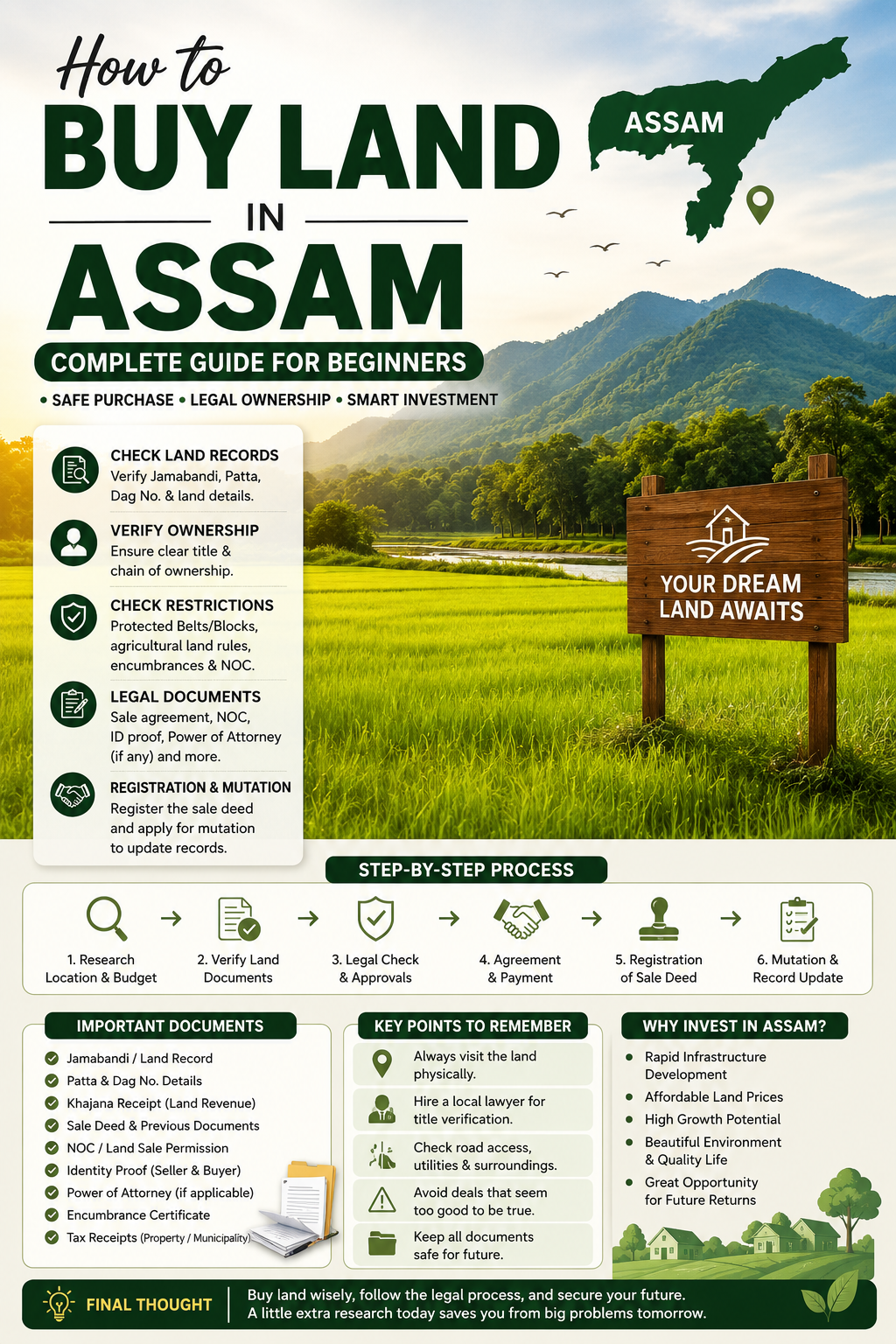
This guide explains the process step by step—from choosing land and checking ownership to registering the sale deed and getting the land mutated in your name.
Important: Land transactions are legally significant. Rules can differ by district, land category and location, so have a qualified property lawyer or competent local revenue professional verify the specific plot before you pay a substantial amount.
1. Decide What Type of Land You Want
Before searching for a plot, decide what you actually want to use it for.
Common purposes include:
- Building a house
- Constructing apartments
- Commercial use
- Farming
- Industrial purposes
- Investment
- Developing a residential plot
- Building a weekend home
The intended use matters because agricultural land cannot simply be treated as residential or commercial land without complying with applicable reclassification/conversion requirements. Assam’s agricultural-land law requires prior permission/reclassification for certain non-agricultural use or transfer.
Ask yourself:
- How much land do I need?
- What is my maximum budget?
- Do I want agricultural or residential land?
- Do I need road access?
- Do I need electricity and water?
- Is the land inside a municipal/development authority area?
- Am I buying for immediate construction or long-term investment?
2. Understand Assam’s Land Terminology
A beginner should understand a few terms before purchasing land.
Dag Number
The Dag number identifies a particular parcel of land in Assam’s land records.
Patta Number
A patta relates to the landholding/settlement record.
You may encounter different forms of patta/settlement status, so don’t assume that every document described as a “patta” gives identical rights.
Jamabandi
Jamabandi is an important land record containing information about the land and recorded landholder.
Khajana
Khajana is the land revenue payment receipt.
An up-to-date revenue receipt is an important document to check.
Mutation
Mutation means updating the land records to reflect the new owner after a transfer. Assam’s Mission Basundhara service specifically provides for mutation after deed registration, including entering the new owner’s name in the land records.
NOC / Land Sale Permission
Depending on the location and nature of the property, permission/NOC may be required before transfer or registration.
3. Check Whether You Are Legally Eligible to Buy the Land
This is one of the most important steps in Assam.
You should not assume that because a seller is offering a plot for sale, you are automatically eligible to purchase it.
Protected Belts and Blocks
Assam has Protected Belts and Blocks governed by Chapter X of the Assam Land and Revenue Regulation, 1886.
These areas have restrictions on transfer of land to protect specified protected classes. The government specifically states that transfer by sale, mortgage, lease or agreement can be restricted in these areas.
Assam’s Land Policy also directs authorities to ensure that non-eligible persons do not acquire land in Protected Belts and Blocks.
Therefore, before buying:
Ask the Circle Office/revenue authority:
“Is this Dag located inside a Protected Belt or Block?”
And ask:
“Am I eligible to purchase this particular land?”
Do not rely solely on the seller or broker’s verbal statement.
4. Be Careful With Tribal and Autonomous Areas
Some parts of Assam have additional land-administration arrangements.
For example, Karbi Anglong and Dima Hasao have their own district-level land administration framework, while several autonomous council areas also have specific arrangements.
Therefore, if you are buying in areas such as:
- Karbi Anglong
- Dima Hasao
- Tribal Belt/Block areas
- Areas under autonomous councils
get specific legal advice before proceeding.
5. Verify the Seller’s Ownership
Never purchase land simply because someone possesses it.
You need to establish that the seller has the legal right to transfer the land.
Ask for:
- Original sale deed
- Previous title deeds
- Jamabandi
- Patta details
- Dag number
- Patta number
- Latest land revenue receipt
- Mutation records
- NOC/permission, where applicable
- Identity documents
- Inheritance documents, if applicable
- Power of Attorney, if applicable
The Assam government’s land-service information specifically lists documents such as Jamabandi, Khajana receipt and registered deed in land-related processes.
6. Check the Entire Chain of Ownership
This is called checking the title chain.
Suppose the seller says:
“I bought this land from Mr. A.”
Don’t stop there.
Find out:
Current seller → previous owner → earlier owner → original title
Your lawyer should examine the relevant historical documents and determine whether the seller obtained valid title.
Why this matters
A property can have:
- Multiple heirs
- Undisclosed co-owners
- Old sale agreements
- Family disputes
- Court cases
- Mortgage/charge
- Incorrect mutation
- Boundary disputes
- Previous transfers
A registered document alone doesn’t mean you should skip title verification.
7. Check for Existing Loans or Encumbrances
Before purchasing, determine whether the land is subject to:
- Mortgage
- Bank loan
- Court attachment
- Sale agreement
- Government acquisition
- Other legal claims
- Family dispute
- Revenue dispute
You should obtain an appropriate Non-Encumbrance Certificate/search and have a lawyer conduct a title search.
Assam’s e-District services include an application process for a Non-Encumbrance Certificate requiring land deed/land record information and supporting documents.
8. Check the Jamabandi
The Jamabandi is one of the most important records to examine.
Compare the:
- Seller’s name
- Dag number
- Patta number
- Land area
- Land classification
- Possession details
- Revenue status
with the actual property and sale documents.
Assam’s Integrated Land Records Management System/Dharitree provides access to land-record-related services.
Don’t rely on one document
Ideally, compare:
Jamabandi + title deed + revenue receipt + physical survey + registration records
9. Verify the Dag Number and Land Area
Suppose a seller says:
“I am selling 2 bighas.”
Don’t accept the measurement blindly.
Verify the official land record and conduct a physical measurement/survey.
Check:
- Dag number
- Total recorded area
- Area being sold
- Boundaries
- North/South/East/West boundaries
- Road access
- Adjacent plots
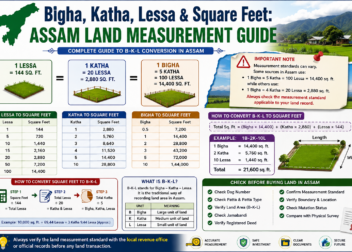
Assam land records may use local measurements such as Bigha, Katha and Lessa, so ensure that the area in the agreement and deed matches the official record.
10. Get a Physical Land Survey
This step is frequently ignored by first-time buyers.
Hire a qualified surveyor to verify the boundaries.
The survey should establish:
- Actual location
- Boundary lines
- Total area
- Road access
- Encroachment
- Neighbouring plots
- Drainage/water bodies
- Existing structures
Red flag
If the seller says:
“No need for measurement; everyone knows the boundary.”
Don’t proceed without verification.
11. Check Road Access
A cheap plot with poor access can become an expensive mistake.
Check whether the land has:
- Public road access
- Legally documented access
- Sufficient road width
- Approach road
- Right of way, if required
Don’t assume that a narrow pathway used by villagers automatically provides a legally secure access route.
12. Verify Land Classification
Find out whether the land is:
- Agricultural
- Residential/homestead
- Commercial
- Industrial
- Wetland/water body
- Forest-related land
- Government land
- Other restricted category
This is especially important if you intend to build a house.
13. Agricultural Land Requires Special Attention
If you find inexpensive agricultural land and plan to build a house, don’t assume you can simply buy it and start construction.
Assam’s Agricultural Land (Regulation of Reclassification and Transfer for Non-Agricultural Purpose) Act, 2015 regulates the reclassification and use of agricultural land for non-agricultural purposes. Government material states that agricultural land cannot be used or transferred for intended non-agricultural purposes without the required reclassification and permission.
Mission Basundhara also provides services related to reclassification.
Example
If you purchase agricultural land because it is cheap and later discover that you cannot legally use it for your intended residential project without conversion/reclassification, your project could be delayed and become significantly more expensive.
14. Check Whether the Land Is Annual Patta or Periodic Patta
This is another important issue in Assam.
The nature of the patta/settlement affects the rights associated with the land and its transferability.
Mission Basundhara currently includes a service for conversion of eligible Annual Patta land to Periodic Patta, subject to applicable requirements.
Therefore, don’t simply ask:
“Does the land have a patta?”
Ask:
“What kind of patta is it, and is it legally transferable for my intended purchase?”
15. Check Whether the Land Is Government Land
Never buy land that is actually:
- Government land
- Khas land
- PGR land
- VGR land
- Forest land
- Road reserve
- Water body
- Other protected/common land
Mission Basundhara specifically addresses government Khas and ceiling-surplus land and other categories of land settlement.
A person occupying land does not automatically become its lawful owner.
16. Check for Government Acquisition
Ask whether the property is affected by:
- Proposed road widening
- Highway project
- Railway project
- Airport development
- Industrial project
- Government acquisition
- Master Plan road
- Urban development project
This is particularly important around rapidly developing areas.
17. Check Master Plan and Zoning
If you are buying around Guwahati or another developing urban area, check the applicable planning authority.
For Guwahati, GMDA has land-use and development-planning functions and current policies affecting land development.
Check whether the plot falls under:
- Residential zone
- Commercial zone
- Agricultural zone
- Industrial zone
- Road reservation
- Green/open space
- Other restricted zone
18. If Buying in Guwahati, Check GMDA/GMC Requirements
For certain transactions involving land sale, transfer or subdivision within the relevant Guwahati metropolitan framework, additional permission/NOC requirements can apply.
GMDA’s current land-sale NOC guidance lists documents including:
- Land sale permission from Deputy Commissioner
- Land ownership particulars
- Trace map
- Affidavit
- Layout plan where applicable
- Buyer/seller photographs
GMDA also currently states a 1% development fee for its applicable land sale/transfer/subdivision NOC, calculated on the land value excluding building value.
This should not be assumed to apply to every land purchase throughout Assam.
19. Check Land Sale Permission/NOC
Depending on the district and property, you may need land-sale permission/NOC from the appropriate authority.
District government guidance states that applications for land-sale NOC can be made through the relevant Circle Office, with required documents and applicable fees.
Documents can include:
- Buyer and seller photographs
- Declaration of consideration
- Updated Khajana receipt
- Citizenship proof of purchaser
- Land Patta
- Affidavit
- Photo ID
- Power of Attorney, if applicable
Requirements can vary, so confirm them with the concerned Circle Office.
20. Check the Seller’s Identity
Verify the seller using appropriate government-issued identification.
Compare the name across:
- ID
- Jamabandi
- Patta
- Previous deed
- NOC
- Sale agreement
Small spelling differences should not simply be ignored.
21. If the Seller Is Using Power of Attorney
Be extremely careful when purchasing from a Power of Attorney holder.
Check:
- Original POA
- Whether it is registered where required
- Whether it specifically authorises sale
- Whether the principal is alive
- Whether the POA has been revoked
- Identity of the principal
- Authority to receive consideration
Assam government land-service documentation specifically calls for a POA copy where the seller is an attorney holder and may require an affidavit from the pattadar.
Have a lawyer independently verify the POA.
22. If the Owner Has Died, Check All Legal Heirs
If the land belongs to a deceased owner, don’t purchase from only one family member without establishing who legally owns the property.
You may need documents such as:
- Death certificate
- Legal-heir/next-of-kin documentation
- Inheritance documents
- Mutation records
- Consent/release documents where applicable
District government guidance for mutation after inheritance lists documents including death certificate, revenue receipt and next-of-kin documentation.
23. Check for Family Disputes
Ask:
“Is there any family dispute regarding this land?”
Also search for litigation where appropriate.
Be particularly cautious when:
- Only one heir is selling
- Multiple names appear in the Jamabandi
- Family members disagree
- The seller says “I’ll get signatures later”
- The property came through inheritance
24. Verify Property Tax and Land Revenue
Before closing the transaction, check that applicable government dues are up to date.
Ask for:
- Latest Khajana receipt
- Municipal/property tax receipts, where applicable
- Other applicable dues
Do not assume that unpaid government dues disappear when ownership changes.
25. Check Utilities
If you plan to construct a house, verify:
Electricity
- Is an electricity connection available?
- How far is the nearest connection?
Water
- Is municipal water available?
- Is groundwater feasible?
- Are there restrictions?
Drainage
- Does the area flood?
- Is there proper drainage?
Internet
- Is broadband/mobile connectivity available?
These issues can significantly affect the actual value of land.
26. Check Flood Risk
Flooding is particularly important when purchasing land in Assam.
Visit the property during or after heavy rainfall if possible.
Check:
- Historical flooding
- Waterlogging
- Drainage
- Nearby rivers
- Low-lying areas
- Embankments
- Soil condition
- Road accessibility during monsoon
A plot that looks excellent during winter can have serious problems during the monsoon.
27. Research the Market Price
Never depend entirely on the seller’s quoted price.
Compare:
- Nearby recent transactions
- Local listings
- Government valuation/zonal value
- Road frontage
- Location
- Plot size
- Land classification
- Development potential
Assam government e-District services also include land valuation certificate services based on documents such as Jamabandi, revenue receipt, land documents and zonal value statement.
28. Calculate the Full Cost
The land price is not your total cost.
Your budget should include:
Expense What to consider Land price Negotiated purchase price Stamp duty Applicable Assam rate Registration fee Applicable rate NOC/permission If applicable Development fee Where applicable Lawyer Title verification/drafting Surveyor Boundary measurement Brokerage If applicable Mutation Applicable process/charges Conversion/reclassification If applicable Construction Future cost Boundary wall Optional Utility connection If required Assam’s Inspector General of Registration publishes the current stamp-duty and registration-fee schedules/notifications; check the official schedule applicable to your deed and property rather than relying on an old percentage found online.
29. Don’t Pay a Large Token Amount Too Early
One of the biggest mistakes beginners make is paying a large advance immediately after seeing a property.
Before paying substantial money, ideally verify:
Title → Jamabandi → Patta → Dag → Land category → Restrictions → NOC → Encumbrance → Physical survey
If an advance is necessary, use a properly drafted agreement that clearly states what happens if the seller cannot establish transferable title.
30. Prepare a Sale Agreement
Before the final sale deed, the parties may enter into an agreement recording the commercial terms.
It should clearly mention:
- Buyer
- Seller
- Property description
- Dag number
- Patta number
- Area
- Sale price
- Advance paid
- Balance amount
- Completion date
- Documents seller must provide
- NOC responsibility
- Registration responsibility
- Consequences of default
- Refund terms
- Encumbrance declaration
- Possession terms
Have a property lawyer draft/review it.
31. Draft the Sale Deed Carefully
The sale deed is the main transfer document.
It should accurately describe:
- Seller
- Buyer
- Consideration
- Dag number
- Patta number
- Area
- Boundaries
- Nature/classification of land
- Previous title
- NOC/permission details
- Possession
- Encumbrance declaration
- Rights being transferred
A spelling mistake or incorrect land description can create problems later.
32. Pay Stamp Duty and Registration Charges
The applicable stamp duty and registration fee need to be paid according to the prevailing Assam rules and the nature/value of the deed.
The Inspector General of Registration’s official website publishes separate resources for stamp duty and registration fees.
Tip: Before registration, get the exact payable amount confirmed through the appropriate registration authority/professional.
33. Register the Sale Deed
The parties then complete registration at the appropriate Sub-Registrar/registration office.
Generally, the process involves:
- Finalising the deed
- Paying applicable stamp duty
- Paying registration fee
- Presenting the document
- Verification of parties
- Photographs/biometric or other required formalities
- Admission/execution of the deed
- Registration
- Obtaining the registered document
The Assam IGR provides information on registration offices and deed-registration fees.
34. Collect the Registered Sale Deed
After successful registration, make sure you obtain the registered document/certified copy as appropriate.
Keep:
- Original/certified registered deed
- Payment receipts
- NOC
- Previous title documents
- Jamabandi
- Survey documents
- Agreement
- Tax/revenue receipts
Store digital scans in a secure location as well.
35. Apply for Mutation
Registration and mutation are not the same thing.
Registration records the transaction/deed.
Mutation updates the revenue/land records to reflect the new owner.
Assam’s Mission Basundhara provides a Mutation after Deed Registration service, and its current guidance describes the process of recording the transfer in the new owner’s name.
Typical information includes:
- District
- Circle
- Village
- Dag
- Deed number
- Deed date
- NOC number/date
- Seller details
- Buyer details
- Area transferred
36. Obtain the Updated Land Record
After mutation, verify that the land record correctly reflects:
Your name + correct Dag + correct area + correct land details
Don’t simply assume mutation has been completed because you submitted an application.
Download/obtain the relevant updated record and check it.
37. Keep a Complete Property File
Create one physical and digital folder containing:
Ownership documents
- Registered sale deed
- Previous deeds
- Jamabandi
- Patta
Revenue documents
- Khajana receipts
- Mutation order
- Updated land records
Permissions
- NOC
- Land sale permission
- Conversion/reclassification order
- Development authority permissions
Technical documents
- Survey
- Trace map
- Site plan
Payment documents
- Bank transfers
- Receipts
- Stamp-duty payment
- Registration fee
This will make future sale, inheritance or construction much easier.
Documents Checklist for Buying Land in Assam
Documents to obtain from the seller
- Original title deed
- Previous title deeds
- Jamabandi
- Patta document
- Dag details
- Latest Khajana receipt
- Mutation record
- NOC/land-sale permission, if applicable
- Encumbrance/search report
- Seller’s ID
- Seller’s PAN, where applicable
- Power of Attorney, if applicable
- Inheritance documents, if applicable
- Conversion/reclassification documents, if applicable
- Survey/trace map
- Property-tax receipts, where applicable
Red Flags You Should Never Ignore
🚩 Seller refuses to show original documents.
🚩 Seller says, “You don’t need a lawyer.”
🚩 Seller asks for a large cash payment.
🚩 Seller says registration can happen later.
🚩 Seller cannot explain the ownership history.
🚩 Dag number doesn’t match the documents.
🚩 Area in the deed doesn’t match the physical land.
🚩 Land is being advertised as residential but records show agricultural use.
🚩 Seller says “patta is enough” without explaining the patta type.
🚩 Land is inside a Protected Belt/Block but seller says “outsiders can buy easily.”
🚩 Only one heir is selling inherited land.
🚩 Seller is selling through POA without clear authority.
🚩 There is no proper road access.
🚩 The property floods regularly.
🚩 The seller promises that “conversion will happen automatically.”
🚩 The property is government/Khas/PGR/VGR/forest or otherwise restricted.
A Simple Example
Imagine you find a plot near Guwahati for ₹30 lakh.
The seller says:
“The land is residential, my name is in the papers, and you can register next week.”
Don’t immediately pay ₹5 lakh as advance.
Instead:
Step 1
Obtain the Jamabandi.
Step 2
Verify the Dag and Patta.
Step 3
Check the seller’s title chain.
Step 4
Check whether the land is in a Protected Belt/Block.
Step 5
Check land classification.
Step 6
Check whether NOC/permission is required.
Step 7
Check encumbrances and litigation.
Step 8
Conduct a physical survey.
Step 9
Confirm road access.
Step 10
Check development/master-plan restrictions.
Step 11
Have a lawyer approve the title.
Step 12
Sign a properly drafted agreement.
Step 13
Pay applicable stamp duty/registration charges.
Step 14
Register the sale deed.
Step 15
Apply for mutation.
Step 16
Verify the updated land record.
Only after completing these steps should you consider the purchase properly secured.
Buying Land in Assam: Complete Step-by-Step Process
1. Decide your purpose
↓
2. Set your budget
↓
3. Find a suitable plot
↓
4. Obtain Dag/Patta/Jamabandi details
↓
5. Verify seller’s ownership
↓
6. Check title history
↓
7. Check Protected Belt/Block restrictions
↓
8. Check land classification
↓
9. Check NOC/permission requirements
↓
10. Check encumbrances and litigation
↓
11. Conduct physical survey
↓
12. Verify road/access and utilities
↓
13. Check valuation and market price
↓
14. Negotiate price
↓
15. Sign sale agreement
↓
16. Prepare sale deed
↓
17. Pay stamp duty & registration charges
↓
18. Register sale deed
↓
19. Take possession
↓
20. Apply for mutation
↓
21. Verify updated land record
Important Assam-Specific Checks
For a beginner, these are the 10 things I would never skip:
Jamabandi verification
Dag and area verification
Seller’s title-chain verification
Patta-status verification
Protected Belt/Block check
Agricultural/non-agricultural classification
NOC/land-sale permission
Encumbrance/litigation search
Physical survey
Mutation after registration
Where to Check Official Assam Land Information
Mission Basundhara
Assam Mission Basundhara official portal
It provides various land-related services, including mutation, reclassification-related services and other land-record services.
Assam Land Records / Dharitree
Assam Integrated Land Records Management System (Dharitree)
Inspector General of Registration
Assam Inspector General of Registration
Use the official IGR resources for current registration-fee and stamp-duty information.
Guwahati Metropolitan Development Authority
For applicable Guwahati-area land-sale, transfer and development requirements, check the current GMDA rules and NOC requirements.
Final Thoughts
Buying land in Assam can be a rewarding long-term investment, but it should never be rushed. For a first-time buyer, the most important lesson is to verify the land before paying for it. Check the seller’s title, Jamabandi, Dag and Patta details, land classification, applicable restrictions, encumbrances, NOCs and the physical boundaries of the property.
Assam’s Mission Basundhara provides important land services such as mutation after deed registration, Annual Patta-to-Periodic Patta conversion and agricultural-land reclassification, making it easier to keep land records updated.
Most importantly, don’t judge a property only by its price or location. A slightly more expensive plot with clear ownership, proper access, correct documentation and legally usable land status can be far safer than a cheap property with complicated title or land restrictions.
Before completing the purchase, have a qualified local property lawyer verify the documents and applicable Assam land rules for the exact Dag and Patta. Once the sale deed is registered, make sure the mutation is completed and the updated Jamabandi reflects your ownership.
In short: verify the title, understand the land, check the restrictions, register properly, and complete mutation. A careful purchase today can protect you from years of legal and financial trouble tomorrow.