10 Things to Check Before Buying Land in Assam: Complete Guide
10 Things to Check Before Buying Land in Assam
Buying land in Assam can be a great investment, but checking the land documents and legal status before paying an advance is extremely important. Assam has specific rules relating to land records, protected belts and blocks, land classification, mutation, NOCs and transfer restrictions.
Here is a practical 10-point checklist for beginners.

1. Verify the Seller’s Ownership
The first thing to establish is whether the person selling the land is actually the legal owner.
Ask for:
- Original registered sale deed
- Current Jamabandi / Record of Rights
- Patta details
- Dag number
- Patta number
- Latest land revenue/Khajana receipt
- Previous title documents
- Mutation records
- Legal-heir documents, if the seller inherited the property
You can check Jamabandi details online through Assam’s official land-record system, including by district, circle, village, patta number and dag number.
Tip: Don’t rely only on a photocopy supplied by the seller. Compare the documents with government records.
2. Check the Dag Number, Patta Number & Area
Make sure the physical land matches the government records.
Check:
- Dag number
- Patta number
- Total land area
- Name of pattadar
- Village/mouza
- Boundary details
- Land classification
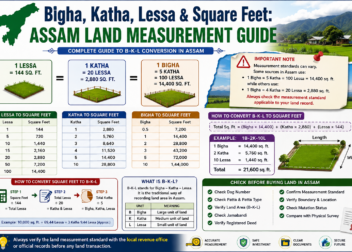
Assam commonly uses Bigha–Katha–Lessa for land measurements, so make sure you understand the exact area being purchased. Government services also use these measurements when processing land records and mutation.
Don’t forget the physical inspection
Take a surveyor or qualified professional to the property and compare the actual boundaries with the recorded land schedule.
3. Check Whether the Land Is in a Protected Belt or Block
This is one of the most important checks in Assam.
Land located in a Protected Belt or Block/Tribal Belt or Block can have significant restrictions on who can acquire it.
The Assam Land and Revenue Regulation, 1886 contains restrictions on transfers in belts and blocks, including restrictions relating to protected classes and permanent residents.
The Assam Government’s Land Policy also specifically directs authorities to prevent transfers in protected belts/blocks that violate these provisions.
Never assume that because the seller is offering the property, you are legally eligible to buy it.
Before paying a substantial amount, verify eligibility with the appropriate revenue authority.
4. Check the Land Classification
Find out exactly how the land is classified.
For example, it may be:
- Agricultural land
- Residential/non-agricultural land
- Commercial land
- Industrial land
- Other restricted categories
If you want to construct a house on agricultural land, you may need the applicable conversion/reclassification process.
Assam’s Mission Basundhara information specifically provides for reclassification when land use changes—for example, agricultural land being changed to residential, commercial or industrial use.
Important
Don’t purchase agricultural land simply because the broker says:
“You can build a house here later.”
Check the legal land-use position first.
5. Obtain and Check the NOC
Depending on the location and nature of the transaction, an applicable No Objection Certificate (NOC) may be required.
Assam’s Integrated Land Records Management System includes an online NOC system for transfer of immovable property.
For example, GMDA has a specific process for NOC for land sale/transfer/subdivision within its jurisdiction.
Check:
- Whether NOC is required
- Whether the NOC has been issued
- Whether the NOC corresponds to the same land
- Whether the seller’s details match
- Whether the dag/patta details match
Never accept a verbal assurance that “NOC will be managed later.”
6. Check for Loans, Mortgages & Legal Disputes
Before buying, make sure the land isn’t already:
- Mortgaged
- Attached by a court
- Involved in litigation
- Subject to inheritance disputes
- Under a previous sale agreement
- Encumbered by another person’s rights
An Encumbrance/Non-Encumbrance Certificate or equivalent title search, together with examination of prior deeds and court records where appropriate, can help identify potential problems.
Government service information in Assam lists land records/deeds and related documents for issuance of a Non-Encumbrance Certificate.
Best practice
Have a property lawyer conduct a title search for the relevant historical period, rather than relying solely on the seller’s statement.
7. Check the Seller’s Mutation & Revenue Receipts
Mutation is important because it records the change in the land record after transfer or inheritance.
Assam’s Mission Basundhara describes mutation after deed registration as the process through which the new owner’s name is recorded and land revenue is charged to the rightful owner.
Check:
- Current Jamabandi
- Mutation order
- Latest Khajana receipt
- Seller’s name
- Area recorded in the seller’s name
- Any remarks/objections in the land record
Important: Mutation should not be treated as a substitute for proper title verification. Your lawyer should examine the underlying title documents too.
8. Check Access Road & Actual Possession
A legally documented plot is not necessarily a practical plot.
Visit the property and check:
- Is there a proper road?
- Is the road shown in the land records/layout?
- Is the road privately owned?
- Is there a right of way?
- Can a car reach the property?
- Are neighbouring owners blocking access?
- Is someone else occupying the land?
Be particularly careful with:
“Road will come soon.”
“The government will make a road here.”
“You can use this neighbour’s land.”
Don’t base a land purchase on verbal promises.
9. Check Flooding, Drainage & Soil Conditions
This is particularly important when buying land in Assam.
Before purchasing, visit the property during or after heavy rain if possible.
Look for:
- Waterlogging
- Previous flood marks
- Low-lying areas
- Drainage problems
- Erosion risk
- River proximity
- Embankment condition
- Soil stability
- Seasonal access problems
Ask nearby residents:
“Does this land flood during the monsoon?”
Their answers can sometimes reveal problems that aren’t obvious during a dry-season site visit.
For construction, consider getting a professional soil investigation where appropriate.
10. Check the Complete Cost Before Paying
The land price isn’t your only expense.
Your budget may need to account for:
- Sale consideration
- Stamp duty
- Registration charges
- NOC-related charges, where applicable
- Mutation-related expenses
- Legal fees
- Surveyor fees
- Conversion/reclassification charges, if applicable
- Brokerage
- Development charges
- Boundary wall
- Filling/earthwork
- Road/access development
- Construction permissions
For example, GMDA currently states a development fee for certain land-sale/transfer/subdivision NOCs within its jurisdiction, so location-specific charges should be checked before finalising your budget.
Documents You Should Ideally Check
Before making the final payment, create a file containing:
Documents You Should Ideally Check
Before making the final payment, create a file containing:
| Document | What to verify |
|---|---|
| Sale deed | Seller’s ownership & previous transaction |
| Jamabandi | Pattadar, area, dag/patta details |
| Patta | Type and ownership details |
| Khajana receipt | Current land revenue status |
| Mutation order | Recorded ownership changes |
| Previous deeds | Chain of title |
| NOC | Whether transfer is permitted |
| Encumbrance/Non-Encumbrance records | Possible claims/charges |
| Land map/trace map | Boundaries and location |
| Conversion/reclassification documents | Permitted land use |
| Seller’s ID | Identity matching documents |
| Legal-heir documents | If inherited |
| Court/dispute records | Pending litigation, if any |
Assam’s land-record systems provide online access to Jamabandi and related land services, while certified copies can be obtained through the appropriate government service channels.
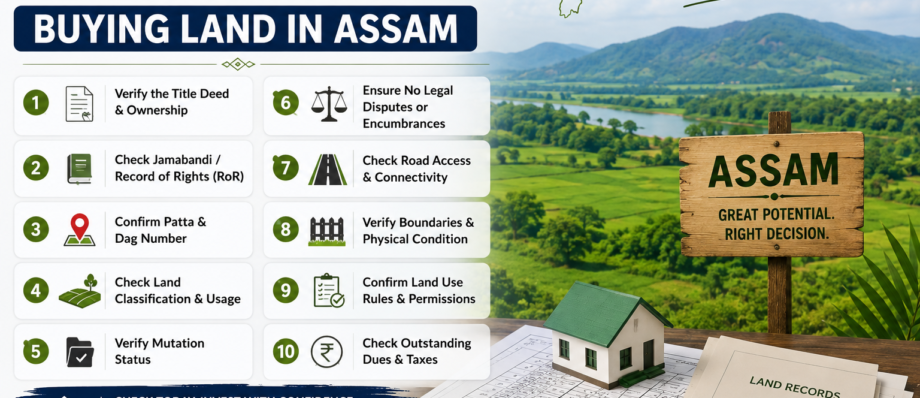
10-Point Quick Checklist
Before buying land in Assam, ask yourself:
- Is the seller the genuine legal owner?
- Does the seller’s name match the Jamabandi?
- Do the Dag and Patta numbers match?
- Does the actual land area match the records?
- Is the property inside a Protected Belt/Block?
- Am I legally eligible to purchase this particular land?
- Is the land classification suitable for my intended use?
- Is the required NOC available?
- Is the property free from known mortgage/dispute/encumbrance issues?
- Is there legal and practical road access?
- Does the land have flood/erosion/drainage risks?
- Have I calculated registration and other additional costs?
- Has a property lawyer checked the title?
- Have I physically inspected and measured the land?
Biggest Mistakes to Avoid
❌ Paying a large advance before document verification
Don’t let a seller or broker pressure you with:
“Someone else is ready to buy it today.”
A few days spent checking documents can save years of legal trouble.
❌ Buying only on the basis of Jamabandi
Jamabandi is important, but a proper title investigation should also examine the chain of documents and possible claims.
❌ Ignoring Protected Belt/Block restrictions
This can be especially serious in Assam because transfer restrictions can apply to land in protected areas.
❌ Believing “conversion will be easy”
Verify the applicable land-use rules before buying.
❌ Ignoring flood history
A cheap plot that regularly floods may become an expensive investment.
❌ Using an unverified broker
Use a qualified property lawyer and, where necessary, a licensed/competent survey professional rather than relying exclusively on the broker.
Final Thoughts
Buying land in Assam can be a valuable long-term investment, but it should never be based solely on price, location, or the seller’s assurances. Before making any payment, buyers should carefully verify ownership, the Jamabandi/Record of Rights, Patta and Dag details, land classification, mutation status, encumbrances, access, boundaries, and applicable land-use restrictions. Assam’s official land-record systems allow buyers to check important property details, making independent verification an essential part of the process.
It is equally important to physically inspect the land and make sure that the property shown to you matches the official records. Any mismatch in the owner’s name, area, Patta number, Dag number, boundaries, or land classification should be treated as a warning sign. Buyers should also confirm that there are no outstanding disputes, acquisition issues, or other restrictions affecting the property.
Most importantly, do not rush because of a “limited-time” price or pressure from a seller. Have the documents examined by a qualified property lawyer before signing an agreement or paying a substantial advance. A little professional due diligence can prevent years of legal and financial trouble.
In short, the safest approach is simple: verify the documents, verify the land, verify the seller, and verify the legal status before you buy. In Assam, checking official land records and keeping the revenue records properly updated are particularly important steps.
Useful official resources
Assam ILRMS / Dharitree land records
Assam Mission Basundhara land services
Assam Land & Revenue Regulation, 1886
Final takeaway: A good piece of land is not just land in a good location—it is land with a clear, legally verifiable title and no hidden complications.