How to Check Jamabandi Land Records Online in Assam – Complete Guide
How to Check Jamabandi Land Records Online in Assam
If you own land in Assam or are planning to buy land, checking the Jamabandi (Record of Rights/Chitha) is one of the most important steps. Assam provides an official online system through ILRMS (Integrated Land Records Management System) and its Dharitree/Jamabandi service.
What is Jamabandi?
Jamabandi is an important land record containing information about a parcel of land and its recorded pattadar/landholder. Depending on the record, it can help you check details such as:
- Pattadar/landholder name
- Patta number
- Dag number
- Land area
- Revenue village
- Mouza/Porgona
- Circle
- Nature/type of land
- Land revenue-related information
- Other entries recorded in the Record of Rights
The Assam government makes Jamabandi information available online through its land-record system. The official portal currently provides options for viewing Jamabandi and transliterated versions in multiple Indian languages.
How to Check Jamabandi Online in Assam
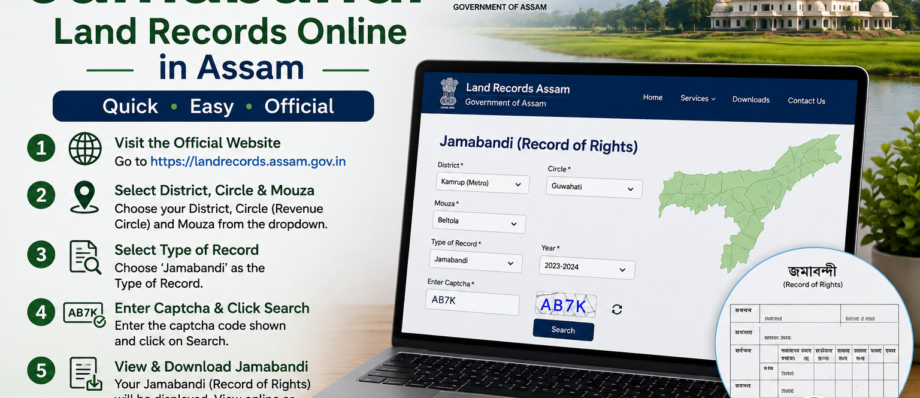
Step 1: Open the official Assam land-record website
Go to the Assam Government’s ILRMS portal.
You can also directly access the Jamabandi viewing service:
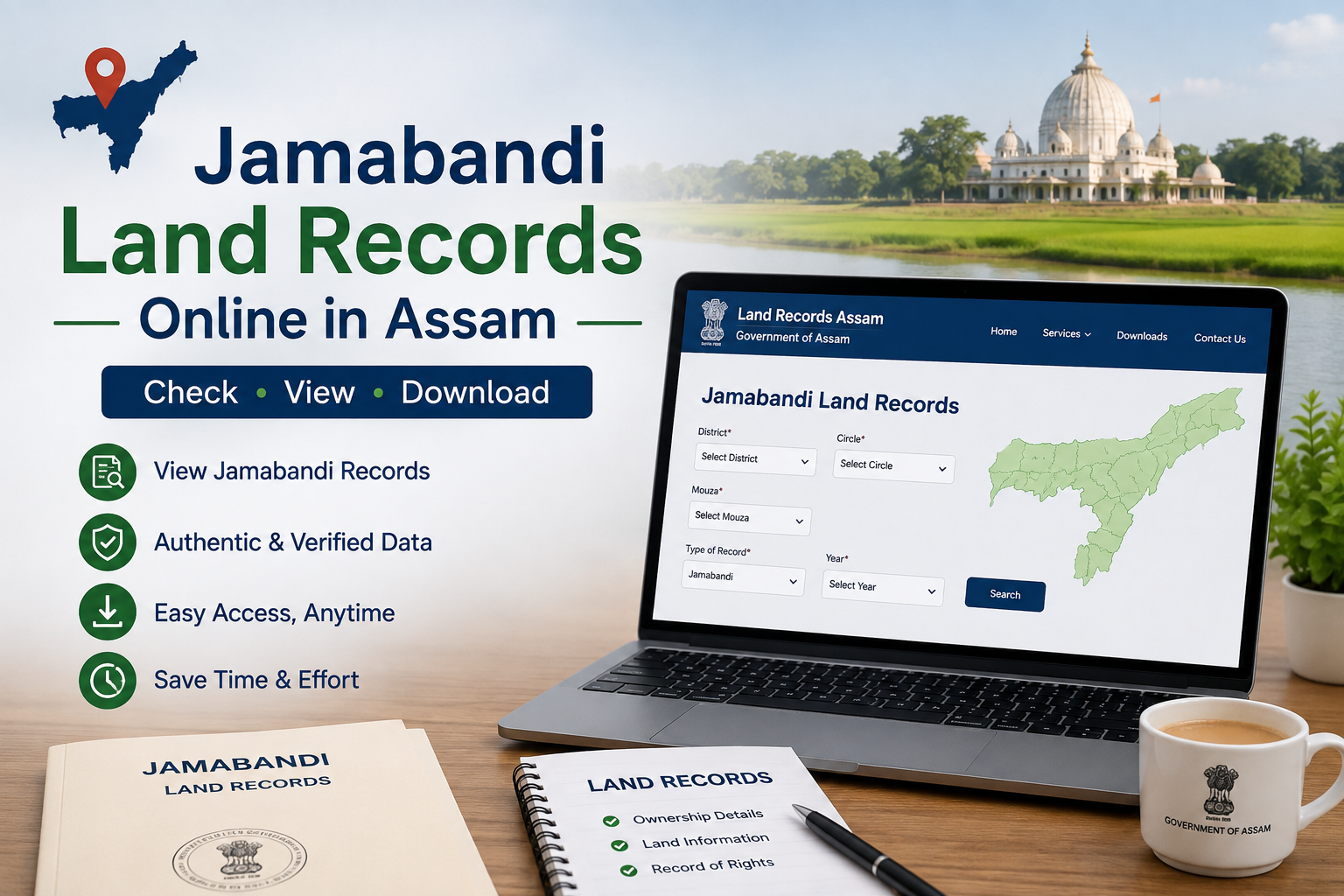
The official Jamabandi page provides fields for selecting the land’s location and search details.
Step 2: Select the location
You will generally need to select:
- District
- Sub-Division
- Circle
- Mouza/Porgona
- Lot
- Village
- Patta Type
The exact options displayed depend on the location selected.
Step 3: Select your search method
The portal provides search criteria such as:
- Patta Number
- Dag Number
If you already have the Patta Number, searching with it can be convenient. If you know the Dag Number, you can use that instead.
Step 4: Enter the required number
Enter your:
Patta No. or Dag No.
Then enter the captcha shown on the page.
Step 5: Click “Display”
After entering the information, select Display.
If the information is available in the database, the relevant Jamabandi record should be displayed.
What Information Should You Check in Jamabandi?
When the record appears, don’t simply check the owner’s name. Carefully compare all the important details.
1. Pattadar’s name
Check whether the name recorded in the Jamabandi matches the seller’s name and supporting documents.
Pay attention to:
- Spelling
- Father’s/husband’s name
- Multiple pattadars
- Joint ownership
A mismatch doesn’t automatically mean the seller has no rights, but it should be investigated before purchasing.
2. Patta Number
The Patta Number identifies the landholding/account in the land records.
Compare the Patta Number with:
- Sale deed
- Previous title documents
- Land revenue receipt
- Other land records
3. Dag Number
The Dag Number identifies the particular parcel of land.
Make sure the Dag Number in the Jamabandi corresponds with the documents and the actual property you are considering.
4. Land area
Check the recorded area carefully.
For example, if a seller claims that a plot contains a particular area, compare that claim with the area recorded in the Jamabandi.
5. Classification/nature of land
Check how the land is recorded.
This is particularly important if you intend to construct a house, purchase commercial property, or develop the land.
Do not assume that every parcel shown online is automatically suitable for your intended use. Land classification, conversion requirements, zoning and other restrictions may need separate verification.
Patta vs Dag Number: What’s the Difference?
These two terms are often confusing for first-time land buyers.
| Term | Basic meaning |
|---|---|
| Patta Number | Identifies a landholding/account |
| Dag Number | Identifies a particular parcel/plot |
| Pattadar | Person(s) recorded as holding the land |
| Jamabandi | Record containing landholding/rights information |
| Chitha | Land record containing details of the parcel and related entries |
For a property purchase, you should ideally understand all of these together, rather than relying on only one number.
Can You Search Jamabandi by Owner Name?
The official Jamabandi interface currently displays location fields and search criteria including Patta No. and Dag No.
Therefore, if you only know someone’s name and don’t have the Patta or Dag number, you may need to first obtain the property’s location and relevant land-record details.
For difficult cases, contacting the concerned Circle Office or using the appropriate government land-record service may be necessary.
How to Download/Obtain a Jamabandi Copy
There is an important distinction between viewing online information and obtaining a certified copy.
The Assam Government’s Dharitree service specifically states that the information displayed online is for viewing and that, for an up-to-date certified copy of Jamabandi/Record of Rights, citizens should use the RTPS Assam service; it also says a physical visit to the service delivery office is not required for that online service.
RTPS Assam – Government Services
So, for an important legal transaction, don’t treat a screenshot or ordinary online display as equivalent to a certified copy.
How to Check Land on a Map
Assam’s ILRMS ecosystem also includes Bhunaksha, a cadastral mapping system.
Bhunaksha can be useful when you want to understand the spatial/map representation of a land parcel.
For a land purchase, comparing:
Jamabandi + cadastral map + registered deed + physical property
is much safer than relying on one record alone.
Why You Should Check Jamabandi Before Buying Land
Checking Jamabandi can help you identify discrepancies before you pay money to a seller.
You can compare:
Seller’s claim → Jamabandi → Sale deed → Dag/Patta → Land map → Physical land
If these don’t match, stop and investigate before proceeding.
Common problems you may discover
- Seller’s name doesn’t match the record
- Incorrect Patta Number
- Incorrect Dag Number
- Difference in land area
- Multiple pattadars
- Old ownership information
- Mutation not reflected
- Land classification issues
- Boundary discrepancies
- Incomplete or outdated records
Jamabandi vs Sale Deed
These documents serve different purposes.
Jamabandi
Shows land-record information maintained by the revenue/land-record authorities.
Registered Sale Deed
Documents a registered transaction transferring property rights between parties.
Important: Seeing someone’s name in Jamabandi should not by itself be treated as conclusive proof that the person has a perfect, marketable title to sell the property.
For a purchase, you should examine the entire title chain and registration records, not just Jamabandi.
What If the Jamabandi Information Is Wrong?
If you find an error, don’t try to correct it by relying on the online display alone.
Depending on the nature of the problem, you may need to approach the appropriate Circle Office/land-record authority or use the relevant Assam Government online service.
Assam’s Directorate of Land Records provides information and services relating to the state’s land-record system.
Directorate of Land Records, Assam
What If the Land Is Not Showing Online?
Don’t immediately conclude that the land is fake or that the seller has no ownership.
Possible reasons can include:
- Record digitization issues
- Incorrect location selection
- Wrong Patta/Dag number
- Historical/legacy records
- Record updating or mutation pending
- Data-entry discrepancies
- Settlement-related issues
Assam’s ILRMS project integrates several land-record applications, including Dharitree, Bhunaksha, Chitha and other services.
If you cannot find the record, verify the information with the appropriate Circle Office/land-record authority.
Important Documents to Collect Before Buying Assam Land
If you’re checking Jamabandi because you’re planning to purchase land, don’t stop there.
Try to obtain and verify:
- Current Jamabandi/Record of Rights
- Patta number
- Dag number
- Registered sale deed
- Previous title documents
- Mutation records
- Up-to-date land revenue receipt
- Land map/cadastral information
- Encumbrance-related information where applicable
- NOC/permissions where applicable
- Identity documents of the seller
- Legal-heir/succession documents where applicable
- Power of Attorney, if someone is selling on another person’s behalf
The Assam Government’s published guidance for certified Jamabandi copies specifically mentions providing complete land details such as Patta No., Dag No., Revenue Village and Mauza, and refers to an up-to-date land revenue receipt/clearance receipt.
How to Verify a Seller Before Buying
A simple verification sequence is:
Step 1
Ask the seller for the Patta Number and Dag Number.
Step 2
Search the official Assam Jamabandi portal.
Step 3
Check the pattadar’s name.
Step 4
Compare the land area.
Step 5
Compare the Dag and Patta numbers with the sale deed.
Step 6
Check the land map/cadastral information.
Step 7
Check mutation and other relevant revenue records.
Step 8
Verify the previous title documents.
Step 9
Check whether there are multiple owners/heirs.
Step 10
Have a qualified property lawyer conduct a title search before making a substantial payment.
Important Warning for Land Buyers
Never purchase Assam land solely because the property appears in an online Jamabandi record.
Online land records are extremely useful for preliminary verification, but a property transaction can involve:
- Title history
- Inheritance
- Registered documents
- Mutation
- Encumbrances
- Court disputes
- Government restrictions
- Land classification
- Boundary issues
- Acquisition proceedings
- NOC requirements
For a high-value purchase, professional legal verification is strongly recommended.
Is Online Jamabandi Information Legally Valid?
The online portal is an official Government of Assam land-record service, but there is an important difference between viewing information online and obtaining a certified copy.
The Assam Dharitree portal itself directs citizens to RTPS Assam for an up-to-date certified copy of Jamabandi/Record of Rights.
Therefore:
Online viewing = useful for checking
Certified copy = preferable when an official document is required
Assam Land Records: Important Official Websites
1. ILRMS Assam
Main integrated land-record system.
2. Jamabandi Search
Direct online Jamabandi viewing service.
3. Dharitree
Assam’s land-record service for viewing land information.
4. RTPS Assam
Useful for government services including certified-document-related services.
5. Directorate of Land Records
Official Assam Directorate of Land Records.
Directorate of Land Records Assam
Common Mistakes to Avoid
❌ Mistake 1: Checking only the seller’s name
The name is only one part of verification.
❌ Mistake 2: Checking only the Patta Number
You should also verify the Dag and location.
❌ Mistake 3: Trusting a screenshot
Use the official portal and obtain certified documents when necessary.
❌ Mistake 4: Ignoring mutation
A sale or inheritance may require corresponding changes in the Record of Rights.
❌ Mistake 5: Ignoring land classification
A parcel’s recorded classification can affect its permitted use.
❌ Mistake 6: Ignoring multiple owners
Joint ownership and inheritance can create complications.
❌ Mistake 7: Paying a large advance before verification
Complete due diligence first.