Annual Patta vs Periodic Patta in Assam: Complete Guide to Patta Types
Patta Types in Assam: Annual Patta vs Periodic Patta
When buying, selling, inheriting, or checking land in Assam, understanding the type of Patta is extremely important. Two of the most common types are Annual Patta (AP) and Periodic Patta (PP).
The main difference is simple:
- Annual Patta generally provides a limited, annually renewable tenure.
- Periodic Patta provides a much stronger and longer-term right, with the official Basundhara service describing PP rights as permanent, heritable and transferable after conversion from AP.
1. What is a Patta?
A Patta is an official land record connected with the land rights of a recorded landholder, commonly called the Pattadar. Assam land records can be checked through the official Dharitree/ILRMS Jamabandi system, which allows searches using location details and Patta-related information.
In simple terms:
- Patta = record of landholding/settlement rights
- Pattadar = the recorded person associated with those rights
- Dag Number = plot identification number
- Jamabandi = Record of Rights containing important land-record details
However, a Patta should not be treated as the only document needed to prove title in every legal transaction. The full chain of title, registered deeds, mutation, possession, encumbrances and other records may also need verification.
2. What is Annual Patta?
An Annual Patta, commonly known as AP, generally refers to land settled on an annual or limited tenure basis.
The Assam government describes AP land in its Basundhara service guidelines as land where the landholder’s rights are limited to yearly leases, before conversion to the longer-term Periodic Patta status.
Main characteristics of Annual Patta
- Usually settled for a limited yearly tenure
- Does not automatically provide the same level of long-term rights as PP land
- Land rights can be subject to government conditions and applicable settlement rules
- Transfer and transaction possibilities may be more restricted
- The holder may need to follow the approved purpose and conditions of settlement
- Eligible AP land may be converted into Periodic Patta through the prescribed government process
Important point
Annual Patta does not simply mean “bad land.” It means the nature of the tenure and rights must be checked carefully before purchasing or transferring the land.
3. What is Periodic Patta?
A Periodic Patta, often called PP, is a stronger form of landholding right compared with Annual Patta.
According to the official Mission Basundhara guidelines, once Annual Patta land is converted into Periodic Patta land, the holder receives permanent, heritable and transferable rights of use and occupancy in the land.
Main characteristics of Periodic Patta
- Long-term or permanent land rights
- Rights can generally pass to legal heirs
- Land is generally transferable, subject to applicable law and restrictions
- Usually considered more suitable for regular land transactions
- Often preferred for residential and investment purposes
- Conversion from AP to PP may be possible if eligibility conditions are satisfied
Because of these stronger rights, PP land is generally considered more secure and marketable than AP land. However, Periodic Patta does not eliminate the need for a complete title and legal verification.
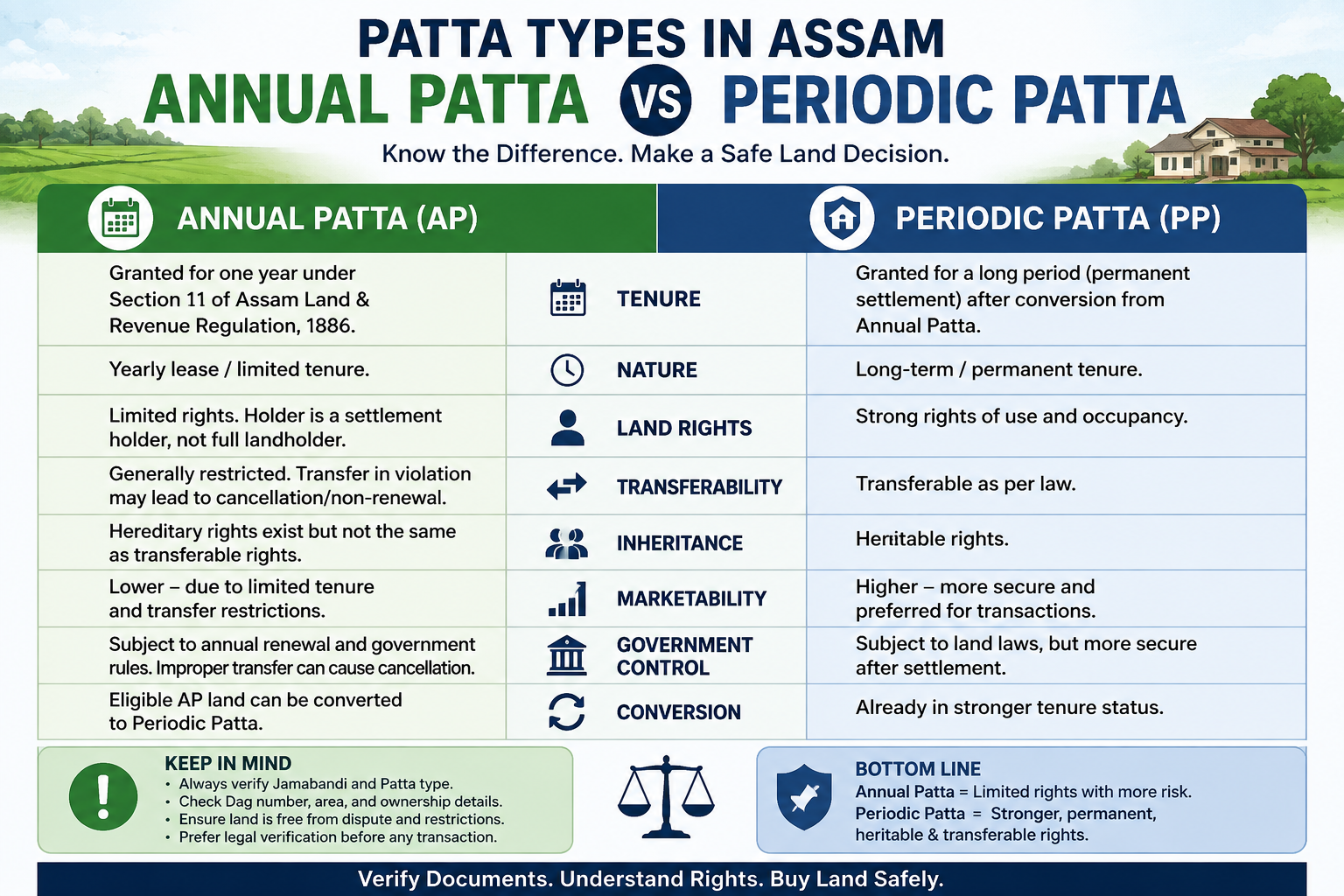
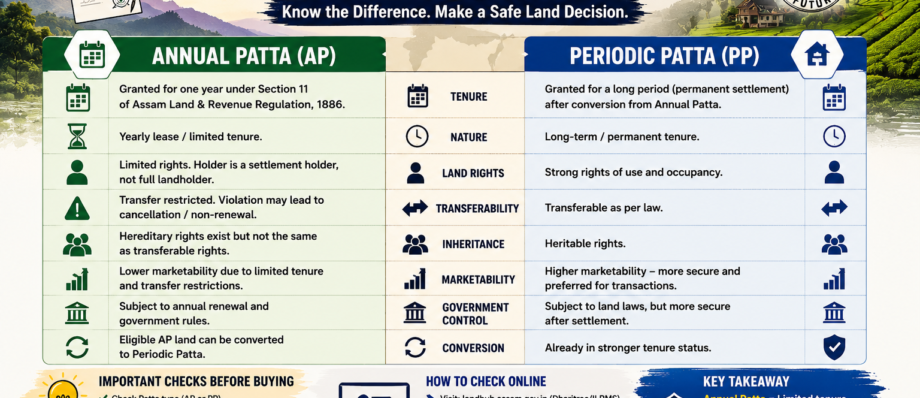
4. Annual Patta vs Periodic Patta: Complete Comparison
| Feature | Annual Patta (AP) | Periodic Patta (PP) |
|---|---|---|
| Full form | Annual Patta | Periodic Patta |
| Nature of tenure | Generally yearly/limited tenure | Long-term settlement |
| Land rights | More limited | Stronger rights |
| Transferability | May be restricted | Generally transferable |
| Inheritance | More limited and subject to rules | Generally heritable |
| Marketability | Usually lower | Usually higher |
| Suitability for buyers | Requires careful legal verification | Generally more preferred |
| Government conditions | May apply more directly | Still subject to applicable laws |
| Conversion | May be converted to PP if eligible | Already stronger tenure status |
The official Basundhara guidelines specifically state that AP-to-PP conversion results in permanent, heritable and transferable rights, subject to the applicable process.
5. Can Annual Patta Be Converted to Periodic Patta?
Yes, in eligible cases.
The Government of Assam provides an official Conversion from Annual Patta to Periodic Patta service through Mission Basundhara. The government has also published official information and notifications relating to AP-to-PP conversion.
General conversion process
- Apply for AP-to-PP conversion.
- Select the relevant district, circle and village details.
- Select the appropriate Dag and land information.
- Enter the applicant and area details.
- Upload the required land revenue receipt and other required documents.
- Submit the application.
- The authorities verify eligibility and applicable conditions.
- The applicant pays any applicable premium where required.
- After approval, the land record is updated to Periodic Patta status.
The exact process and conditions can depend on the location, purpose of land use, applicable land policy and government rules.
6. What Documents Are Generally Required?
The official Basundhara service guidelines list an up-to-date land revenue receipt for the AP-to-PP conversion service. Other official guidance may require additional verification or supporting records depending on the case.
Common documents and records to keep ready may include:
- Annual Patta details
- Jamabandi/Record of Rights
- Updated land revenue receipt
- Dag number
- Land schedule and area details
- Identity documents
- Other documents requested during the official verification process
Always check the current official requirements before applying.
7. Is There a Fee for Conversion?
The fee or premium can depend on factors such as:
- Rural or urban location
- Purpose of the land
- Applicable government rates
- Land valuation
- Applicable notifications and policies
The current official Basundhara service states that there is no premium for AP-to-PP conversion for rural areas, while official government records also contain premium-related provisions for other situations.
Therefore, you should not assume that every AP-to-PP conversion costs the same amount.
8. Can You Buy Annual Patta Land in Assam?
You should be very careful before buying Annual Patta land.
Before paying any advance, verify:
1. Patta type
Confirm whether the land is:
- Annual Patta
- Periodic Patta
- Other special or restricted land category
2. Jamabandi
Check the current official land record and the name of the recorded Pattadar.
3. Conversion eligibility
Find out whether the AP land is eligible for conversion to PP.
4. Transfer restrictions
Verify whether the current holder has the legal right to sell or transfer the land.
5. Government restrictions
Check whether the land is subject to:
- Government conditions
- Land-use restrictions
- Protected land status
- Ceiling laws
- Tribal or other protected-area restrictions
- Acquisition or dispute proceedings
6. Title documents
Check the entire chain of title, registered deeds and previous transactions.
7. Possession
Confirm who is physically occupying the land.
9. Why is Periodic Patta Usually Preferred?
Periodic Patta is generally preferred because it offers stronger and more permanent rights.
The official Assam service guidelines describe PP status after conversion as giving:
- Permanent rights
- Heritable rights
- Transferable rights
This can make the property more suitable for:
- Buying and selling
- Family inheritance
- Long-term residence
- Investment
- Future development
Still, buyers must check whether there are any specific restrictions on the particular property.
10. How to Check Patta Type Online in Assam
You can check Jamabandi information through Assam’s official Dharitree/ILRMS land records portal.
Assam Dharitree / ILRMS Jamabandi Portal
Generally, you will need to select:
- District
- Sub-division
- Circle
- Mouza/Pargana
- Lot
- Village
- Patta type
- Search criteria
- Patta Number or Dag Number
The portal is operated as part of Assam’s Integrated Land Records Management System.
11. How to Apply for AP-to-PP Conversion
The Government of Assam provides the AP-to-PP conversion service through Mission Basundhara.
Mission Basundhara Assam Official Portal
The official service guidelines describe the digital application process and document requirements.
12. Common Myths About Annual and Periodic Patta
Myth 1: Every Patta land can be sold freely
False. The type of Patta and legal restrictions must be checked.
Myth 2: Annual Patta automatically becomes Periodic Patta
False. Conversion requires the prescribed process and eligibility.
Myth 3: Periodic Patta means no further documents need checking
False. A complete legal and title verification is still important.
Myth 4: Every AP-to-PP conversion has the same cost
False. Applicable premium and charges can depend on the location and circumstances.
Myth 5: Jamabandi alone is always enough to prove complete ownership
False. A buyer should also verify registered title documents, mutations, encumbrances, possession and legal restrictions.
13. Which One Is Better: Annual Patta or Periodic Patta?
For most land buyers: Periodic Patta is generally the safer and more desirable option.
Why?
- Stronger land rights
- Better transferability
- Heritable rights
- Greater long-term security
- Usually better marketability
An Annual Patta may still be valuable, but it requires much more careful verification because the holder’s rights may be limited by the settlement conditions and applicable laws.
Here are some additional points you can add to your article to make it more detailed, useful and SEO-friendly.
14. Legal Nature of Annual Patta
Annual Patta is not simply another form of permanent ownership. The official Assam notification states that an AP is granted for one year under Section 11 of the Assam Land and Revenue Regulation, 1886. An AP holder is described as a settlement holder, not a full landholder. The same notification says that, except for hereditary rights, an AP holder does not have a transferable right over the AP land.
This is why a buyer should be especially careful when dealing with Annual Patta land.
15. What Happens if Annual Patta Land Is Transferred Improperly?
This is one of the most important issues in Assam land transactions.
According to the Assam government’s notification, if AP land is transferred in violation of the applicable rules, a proceeding for non-renewal of the Annual Patta may be initiated. The Patta can be cancelled and the land can become government land, after which it may be disposed of or settled according to the applicable land policy.
Therefore, do not assume that a registered-looking sale agreement alone makes an AP land transaction legally safe.
16. Inheritance and Annual Patta
A common misunderstanding is that an AP holder has no family rights over the land. The official notification states that AP holders have hereditary rights, but their rights are not the same as the transferable rights available after valid conversion to PP.
This means inheritance and sale are different legal issues and should not be confused.
17. What Rights Do You Get After Conversion to Periodic Patta?
According to the current Mission Basundhara guidelines, once Annual Patta land is converted into Periodic Patta land, the landholder receives:
- Permanent rights of use and occupancy
- Heritable rights
- Transferable rights
This is the biggest legal and practical advantage of PP over AP.
18. Does Periodic Patta Mean Completely Unrestricted Ownership?
Not necessarily.
Even Periodic Patta land can be subject to:
- Land-use laws
- Land classification rules
- Government acquisition
- Court orders
- Zoning and planning regulations
- Ceiling laws
- Restrictions applicable to specific areas or communities
- Revenue and registration requirements
So, PP status is very important, but a buyer should still conduct a complete legal due diligence process.
19. Annual Patta to Periodic Patta Conversion Is an Official Online Service
The Assam government currently provides AP-to-PP conversion as a digital service through Mission Basundhara. The official portal lists land details, applicant details and an updated land revenue receipt as part of the application process.
Mission Basundhara Official Portal
20. Rural and Urban AP-to-PP Conversion
The applicable process and premium can vary depending on whether the land is located in a rural or urban area.
The current Mission Basundhara service guidelines state that there is no user fee for AP-to-PP conversion in rural areas, while the Assam government also provides services for conversion with rationalised premium rates in towns and peripheral areas.
Because premium rules and notifications can change, applicants should always verify the latest applicable government rate.
21. Documents Required for AP-to-PP Conversion
Depending on the applicable service and location, official Mission Basundhara information may require documents such as:
- Up-to-date land revenue receipt
- Copy of Annual Patta
- Trace map of the scheduled land
- Land details and Dag information
The exact document requirement can vary depending on the applicable service.
22. Why Is the Trace Map Important?
A trace map helps identify the exact portion of land involved in the conversion or transaction.
It can be important when:
- Only part of a Dag is involved
- The land boundaries need to be verified
- There is a boundary dispute
- The buyer wants to confirm the exact physical location
Before purchasing land, compare the map with the actual site.
23. Full or Partial Conversion of AP Land
The official Basundhara process allows applicants to enter the area to be converted. Therefore, the conversion process may involve the relevant scheduled area rather than automatically meaning that every part of a larger holding will be converted in every case.
Always verify:
- Total Dag area
- Area recorded in the Patta
- Area physically possessed
- Area proposed for conversion
24. What if Only Part of the Land Is Being Sold?
This can create an additional layer of complexity.
If only a portion of a Dag or holding is being transferred, verify whether:
- The land is properly demarcated
- The exact area can be legally transferred
- Partition is required
- Mutation and records need updating
- A separate Dag number will be created
Never rely only on verbal boundary descriptions.
25. Mutation Is Not the Same as Patta Conversion
These two terms are often confused.
Mutation generally refers to updating the land record because of a change in circumstances, such as inheritance or a registered transaction.
AP-to-PP conversion changes the tenure status of the land from Annual Patta to Periodic Patta.
Therefore, even if a person’s name is updated in a land record, you must separately check whether the land remains AP or has become PP.
26. Revenue Receipt Is Not Enough to Prove Full Title
An updated land revenue receipt is important, but it should not be treated as the only proof needed before purchasing land.
A careful buyer should also examine:
- Jamabandi
- Patta type
- Registered sale deeds
- Mutation records
- Revenue receipts
- Possession
- Land classification
- Court cases or stay orders
- Government restrictions
A single document rarely tells the complete story.
27. AP Land and Bank Loans
Financial institutions may have their own policies for accepting land as security.
Because AP land has a different tenure and may have transfer restrictions, financing can be more complicated than for a property with stronger and clearly transferable PP rights.
Before purchasing land with a home or land loan, ask the lender:
- Does the bank accept this exact land type?
- Is the Patta status acceptable?
- Is AP-to-PP conversion required?
- What title documents are necessary?
28. Why Buyers Usually Prefer Periodic Patta Land
PP land is generally more attractive because of its stronger long-term rights. It may also provide greater clarity for:
- Sale and purchase
- Family inheritance
- Long-term investment
- Development
- Financing, subject to lender policies
Official Assam guidelines describe PP conversion as giving permanent, heritable and transferable rights.
29. Important Warning for AP Land Buyers
Before purchasing AP land, ask the seller:
- Who was the original AP holder?
- Has the land been transferred previously?
- Was the transfer legally permitted?
- Is the current seller the recorded person?
- Is the seller physically in possession?
- Has an AP-to-PP conversion application been approved?
- Has the land already been converted to PP?
- Is there any cancellation or non-renewal proceeding?
This is especially important because Assam provides a specific service dealing with settlement of AP land transferred from the original AP holder.
30. How to Check Patta Information Online
Assam’s land records system allows citizens to search official Jamabandi information.
Check the:
- District
- Circle
- Village
- Dag number
- Patta number
- Pattadar name
- Patta type
Use the official Assam land records portal and cross-check online records with original documents and current revenue-office records.
Assam Land Records / Dharitree
Quick Comparison: Which Patta Should You Buy?
| Situation | Generally Better Option |
|---|---|
| Long-term land investment | Periodic Patta |
| Residential land purchase | Periodic Patta |
| Easy future inheritance | Periodic Patta |
| Future resale | Periodic Patta |
| Land requiring detailed legal verification | Annual Patta |
| AP land with conversion eligibility | Check conversion first |
| AP land transferred from the original holder | Very careful legal verification required |
Final Thoughts
Understanding the difference between Annual Patta and Periodic Patta is essential before buying, selling, inheriting, or investing in land in Assam. Annual Patta generally represents land settled for a one-year tenure, while Periodic Patta provides stronger and longer-term rights. According to the official Mission Basundhara guidelines, once eligible Annual Patta land is converted to Periodic Patta, the landholder gains permanent, heritable and transferable rights of use and occupancy, subject to applicable laws and conditions.
For most property buyers, Periodic Patta is generally the preferred option because it offers greater long-term security and clearer transfer rights. However, a Periodic Patta alone should never be treated as a complete guarantee of a trouble-free land transaction. Buyers should also verify the Jamabandi, Dag number, mutation status, title history, land revenue receipts, physical possession, boundaries, land classification and any legal or government restrictions.
Annual Patta land requires additional caution because the official Assam land services specifically recognize that the rights are linked to yearly leases and that improper transfer can lead to cancellation and settlement-related consequences. Before purchasing such land, it is important to confirm the seller’s legal rights and whether the land is eligible for conversion to Periodic Patta.
In simple words: Annual Patta requires more careful legal verification, while Periodic Patta generally provides stronger and more secure land rights. Always check official Assam land records and, for any major transaction, obtain independent verification from the relevant revenue authorities and a qualified property lawyer.